This page has information on how to measure your wheels and car to get the right spacer. All you need is a ruler or tape measure!
For a lot more information on wheel spacers, fitments, bolts, studs and more, see our Full Wheel Spacer Info Page.
What Size Should I Use?
This is one of our most commonly asked questions. Unfortunately, it has no easy answer. Picking a spacer that meets your needs is not as easy as it sounds. If it were easy, we'd all be using the same size. There are a few different reasons why people need spacers so every situation ends up being different. But selecting your ideal size is easy by first determining how much available space you have to work with. That means measuring the tire-fender clearance. This empty space will likely be your spacer size. You don't want to exceed the empty space because that will lead to the tire rubbing on the fender. And you don't want to get too thin of a spacer because that may not meet your needs.
Turner Motorsport may be the biggest BMW wheel spacer dealer
in the world. As such we have learned not to make assumptions on spacer size. Every situation is different and the best advice we can give is to
measure your car. It's tempting to listen to what everyone else is running but unless they have your exact wheel, exact tire, exact brake rotor, exact suspension, and exact suspension settings, no one can tell you what spacer size to use. They can only guess... Please keep in mind that spacers that have been installed and tested cannot be returned. This is to be fair to the next customer who expects new, top quality parts from us. Which is all the more reason to be precise about what size you can install.
Here are some easy ways to measure your wheel gap -
The outside of the tire sidewall is usually the widest point of your wheel and tire (unless the tires are 'stretched' across the rim. With the tire/wheel on the car and the car on the ground at its desired ride height, place a straight edge or ruler between the outermost tire spot and the inside of the fender lip. The distance is your wheel gap and your spacer size. This is the max spacer size so it would be a good idea to choose a spacer one size lower to account for suspension travel.
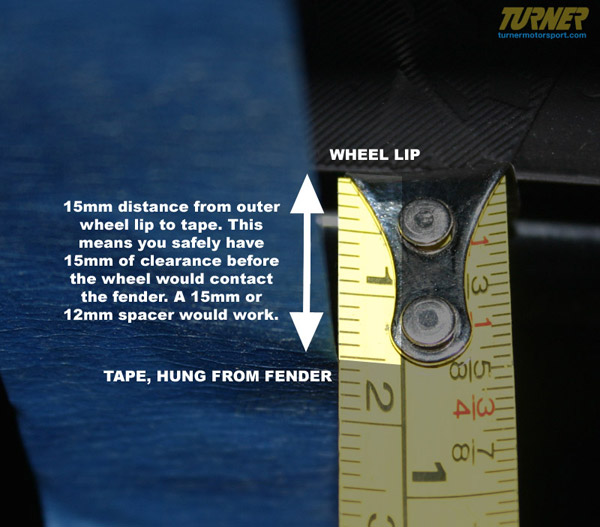
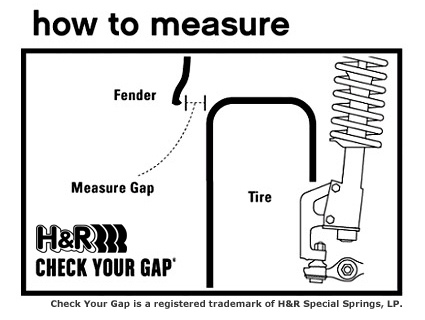 Old-Fashioned Tape Measure
With the car on the ground, hang a piece of masking tape from your fender. Stick a quarter or a nickel on the end so that it hangs straight down. Next measure in from the masking tape to the outside edge of your tire. This will tell you how much space you have until the tire would contact the lip of the fender. Pick a spacer that is slightly less than this measurement. This will ensure the tire does not rub on the fender lip
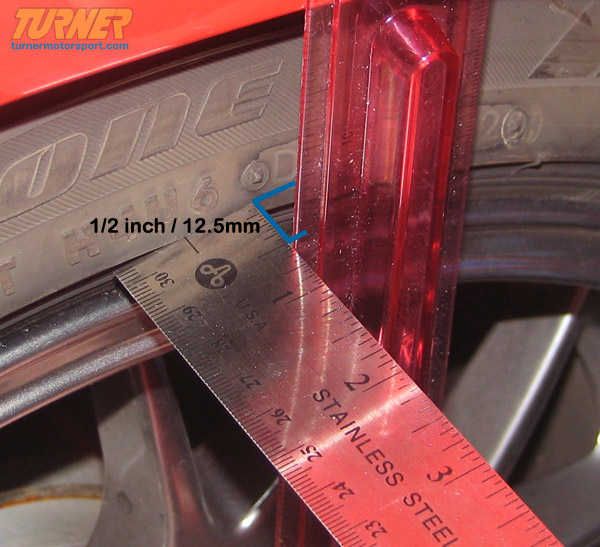
Even More Old-Fashioned Rulers
Same as the method above but if you don't have masking tape to hang from the fender, you can use a straight-edge or ruler and another ruler or tape measure. Gently hold the straight-edge from the bottom of the fender lip. Measure in to the outiside of the tire. The gap between the straight-edge and the tire is your available clearance. Choose a spacer size slightly less than this dimension
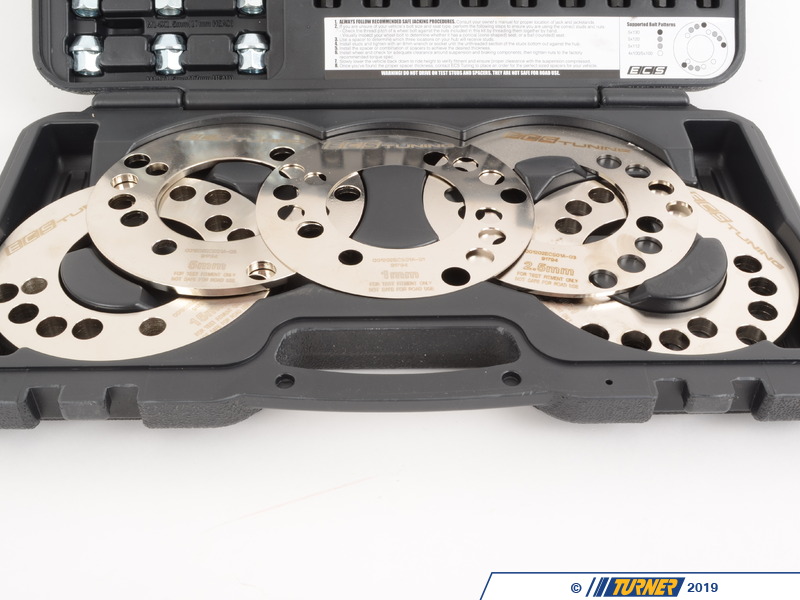
Wheel Spacer Test Fitment Kit
What if you had one of each spacer size on hand to play with? You can swap spacers in and out until you achieved the perfect stance or the right amount of clearance. ECS Tuning put together this slick Spacer Fitment Kit that includes a 1mm, 2.5mm, 5mm, 10mm, and a 15mm spacer along with a variety of wheel studs and nuts. This is a universal kit that they sell for BMW, VW/Audi, MINI, and other makes. The spacers themselves are for test-fitment purposes only - they lack the hubcentric lip and all of the bolt holes required for a final install. This Spacer Fitment Kit is offered for rental or for purchase. Click here to order.
Wheel Studs and Washers
For this method, you would purchase at least two wheel studs to thread into the hub and corresponding nuts to lock the wheel down (link to TMS 90mm studs). Remove your wheel and bolts. Thread the studs into the hub. Place M12-sized washers down the stud to the hub. Slide the wheel over the studs. If it makes contact with the caliper or suspension, add more washers. Once the clearances are set, lock the wheel down with the nuts. Lower the car to the ground and roll - don't drive! - the car back and forth so the suspension will settle. Check your clearances again and also for tire-fender contact. Adjust if necessary. The end thickness of your washers will be your minimum spacer size. If you have space left over before the tire hits the fender, consider going with an even bigger spacer for improved looks.
Remember to remove your studs or install them the proper way before driving.
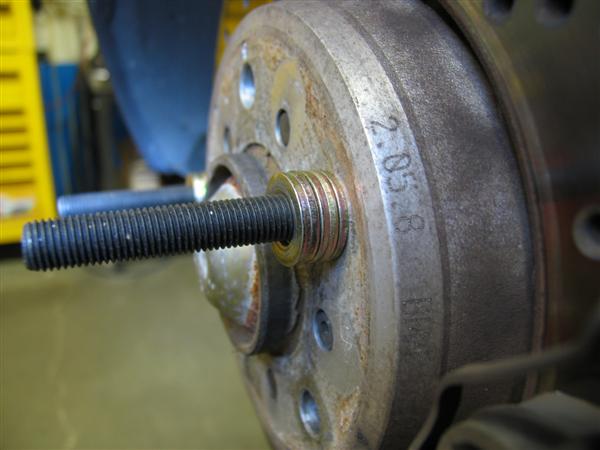
Studs and washers installed in the hub. Pictured is a BBS 90mm stud and 5 washers (roughly 15mm).

Studs and washers installed with the wheel.
BMW Wheel Pin and Washers
If wheel studs are not available to you, you can use the factory BMW wheel pin tool in your tool kit. More than one pin is recommended. This method does not allow you to set the car on the ground as the wheel pin will not support the weight of the car and there is no way to fasten the wheel to the hub. Don't even try it! Remove your wheel from the car. Insert the pins into the hub. Slide M12 sized washers onto the pin down to the hub. Slide your wheel onto the pins until it contacts the caliper, suspension, etc.. Add washers until the wheel sufficiently clears. The thickness of your stack of washers is the size of your spacer.
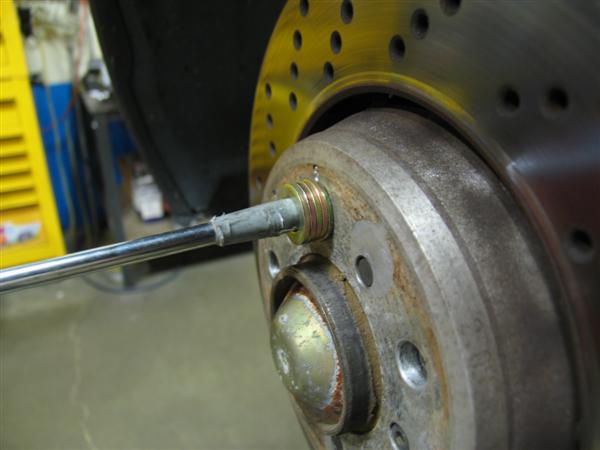
Factory BMW wheel pin tool installed with washers.
Measuring Hub Lip
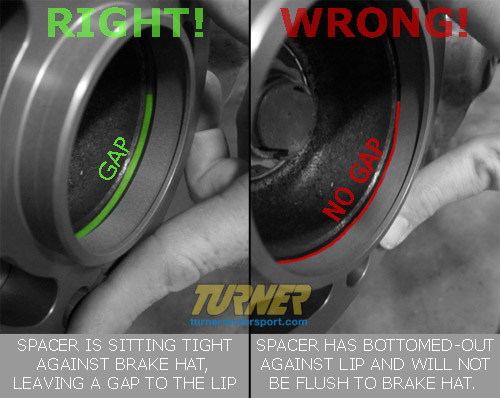
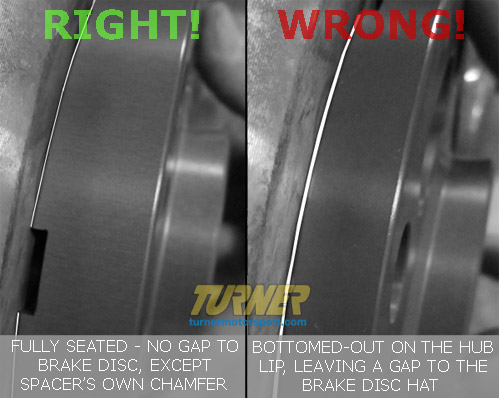
A lot of times we make a reference to measuring your stock hub lip. This is to ensure the spacer fully seats on the lip and against the brake disc hat. If the lip sticks out too far, the spacer will not be fully seated and that can be very dangerous. The spacer must fully seat against the brake rotor hat with no gap left over. If your spacer does not fully seat on the hub you have two choices: buy a wider spacer or shave/file the lip. In most cases, the lip only needs to be shaved by a millimeter or two. The spacer is seated properly when the back of the spacer is fully pressed against the brake rotor and there is a gap between the outer lip and the inside of the spacer.
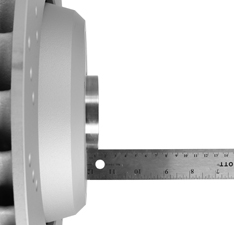
checking hub depth of the stock E9X M3
hub and brake rotor |
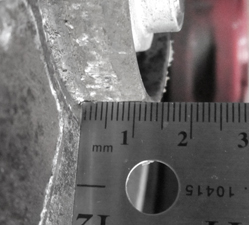
checking hub depth with no spacer
on MINI R56 GP |
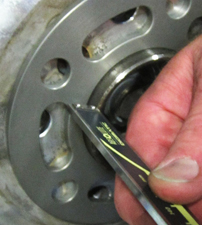
checking hub depth with 5mm spacer
on F30 hub |
 Â
Miscellaneous Notes and Details on Spacers
- Typical Sizing The German TUV (similar to our DOT) requires that all cars be equipped with snow tires or be engineered to accept snow chains. These are still widely used in Europe even though they are obsolete or irrelevant in other markets. That's why most BMWs have the tire tucked so far under the fender. We have found that most BMW models before 2012 can take a 15-20mm spacer when used with the stock wheel/tire setup. Since 2012 it seems as though the TUV has relaxed its policies and snow chains are no longer required. This has allowed BMW and other makers to get more aggressive with their tire sizes and offsets to the point that spacers may not even be wanted.
- Hubcentric Fitments All BMWs use hubcentric wheels. When mounted to the car, the wheel rests on a lip instead of the wheel bolts or studs. The lip contributes to the strength of the wheel and the wheel cannot safely be used without a lip. The wheel bolts are not strong enough to support the weight and loads generated through the wheel. The lip is usually 9-10.5mm in depth and the new spacer must have its own lip. Turner and H&R Spacers with their own integrated hubcentric lip are: 10mm, 12mm, 12.5mm, 15mm, 18mm, 20mm, 25mm, and 30mm.
* -- Note that H&R and Turner Motorsport each make a 10mm hubcentric spacer but due to interferences between the spacer and lip, it's best to leave this to specialized applications. See below for more detail.
- 10mm Fitment Notes You must be very careful when fitting 10mm spacers to any BMW. Since the depth of the hubcentric lip will vary, you risk bottoming out of the spacer before it sits flush with the hub. This will leave a gap between the spacer and the hub, seriously compromising the strength of the spacer. The lip on the car must be shaved down so the 10mm spacer will fit flush on the rotor hat.
- Flat Spacers Any spacer without a hubcentric lip is called a 'flat spacer'. These are usually smaller than 10mm. It's physically impossible to have the lip since the spacer slides over the existing lip but is not thick enough to take the lip's place (the standard lip still protrudes through the spacer). If the original lip is 9mm, a 5mm spacer will only leave 4mm of stock lip left for the wheel to rest on. This is important to keep in mind when considering your wheel/spacer setup. A wheel with a beveled edge on the back will not adequately rest on the lip, resulting in a vibration because the wheel is not truly centered on the hub.
- Hub Extenders For most 5-lug BMW applications, Turner Motorsport offers a front hub-extender. This takes the place of your hub's dust cap and adds an extra 10mm of lip for the wheel to rest on. Using the example above, instead of 4mm left over on the lip, you now have 14mm of lip to use. With the hub extenders, you can also change spacers around without fear of losing lip space - it can be used with a 3mm, 5mm, 8mm, or 10mm flat spacer.
- F30 3-series On the 2012+ F30 3-series models, the available hub depth can vary. This can have an impact on what spacers will fit over the lip and flush against the brake disc hat. It's also different on the front and rear. Measuring the existing hub depth is required before ordering spacers. Selecting a spacer that does not fit securely over the lip will require modification/shaving/trimming of the lip until the spacer sits securely.
For much more information on wheel spacers, fitment, wheel bolts, studs and more, please see our Full Wheel Spacer page.


