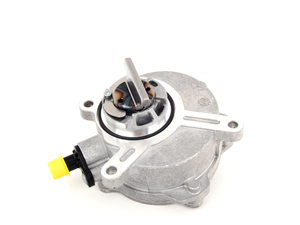
The brake master cylinder is responsible for distributing fluid from the reservoir to the front and rear brake systems. The fluid reservoir actually sits on top of the master cylinder with hard metal brake lines running out of it. There are a few places where the master cylinder can leak and cause a spongy or soft brake pedal. The inside has several pistons with o-rings and seals that can fail and allow brake fluid to escape. Likewise, the external metal lines also have o-rings where fluid can seep out or let air/moisture in.
Most vehicles send engine vacuum from the intake manifold to the brake booster to provide power assistance to the braking system. However, due to your vehicle's engine having different vacuum characteristics, BMW decided to use an electronically operated auxiliary vacuum pump instead. Mounted to the front of the cylinder head, this part serves as the vacuum source and replaces the vacuum your brake booster would be receiving from the intake manifold. An auxiliary vacuum pump failure could cause many symptoms, most commonly a harder-feeling brake pedal resulting in longer stopping distances. A failure could also result in a vacuum leak, triggering a check engine light and potentially causing the engine to stall and run poorly. If your car exhibits any of the above symptoms, it may be time to replace your vacuum pump. Thankfully, this Febi replacement functions identically to the factory component.
Show More Show Less