






Select Vehicle
BMW
Mini
Purpose
Category
- Drive Belts, Pulleys, Tensioners
Please ensure your correct model is selected

This product was last offered at the strikethrough price on
06-14-2026
This product was last offered at the strikethrough price on
06-14-2026
Introducing our Turner Motorsport Crank Seal Guard – the essential shield for your BMW's engine integrity. Safeguarding the heart of your vehicle, this meticulously designed guard offers robust protection for the crank seal concealed behind the harmonic balancer.
Considered an indispensable maintenance component for your BMW, the Crank Seal Guard acts as a crucial defense against a potential and preventable catastrophe involving your accessory belt. Facing the reality of potential oil or coolant leaks in your engine, this guard becomes a reliable barrier, preventing these fluids from reaching the accessory belt. The consequence of a compromised belt includes walking, slipping, fraying, and rubber particles finding their way behind the harmonic balancer and into the crank seal – a scenario that can lead to severe engine failure.
Let's be honest, engine leaks are a common occurrence, and whether your engine is currently leaking or not, the Crank Seal Guard is a proactive measure against future threats. The wear and tear on the accessory belt due to oil and coolant exposure can result in slipping, tearing, or, worst-case scenario, belt snapping – posing a significant risk to your engine's well-being.
Prepare your car for the long haul and protect the vital components, It's not a matter of "if" but "when" your belt will become a problem, and our Crank Seal Guard is your proactive solution. Rigorously tested on N52/N54/N55 and S55 for 100% confirmed fitment, it stands as a reliable guardian for your engine's health. Invest in the protection your BMW deserves with the Turner Motorsport Crank Seal Guard.
Key benefits:
Protect crank seal from rogue accessory belts and their shredded debris
Optimized to fit N52, N54, N55, and S55 engines
Rigid design that fits within the space constraints between the engine block and harmonic balancer
Zinc-coated fasteners for corrosion and oxidation resistance
Design:
Modeled and designed from FARO laser scanning and Solidworks CAD
Manufactured from 6061 billet aluminum
Turner blue anodizing
Installation:
It is a good idea to note how your belt is routed before starting the installation.
2 securing bolts for crank seal guard - Torque value of 20Nm
You will find either 6 or 8 E10 bolts are holding the harmonic balancer depending on the engine.
E10 (P#11237564511)
N52: 6 bolts - Torque value of 25nm
N54: 6 bolts - Torque value of 35nm
N55: 8 bolts - Torque value of 35nm
E10 (P#11237575488)
S55: 8 Bolts - Torque value of 35nm

If you own an M57-equipped BMW, you already know this twin-turbo diesel powerplant is an absolute torque monster. What you might also know is that all that low-end grunt and high-compression diesel vibration wreaks absolute havoc on your accessory drive system.
From the factory, both the E90 335d and E70 X5 35d utilize a rigid alternator pulley. With each cylinder's fire, the crankshaft experiences a violent micro-acceleration. Because the alternator has a heavy internal rotor spinning at high speeds, it wants to keep spinning at a constant rate. When the engine suddenly slows down (even minutely between firing cycles), the alternator fights the belt. This constant tug-of-war results in extreme stress on your engine's belt-driven components. At best, it’s an annoying, unrefined chirp at idle; at worst, it’s a ticking time bomb for your expensive harmonic balancer.
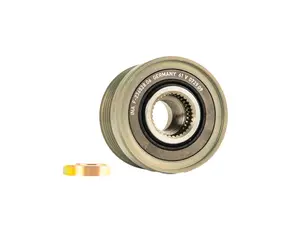
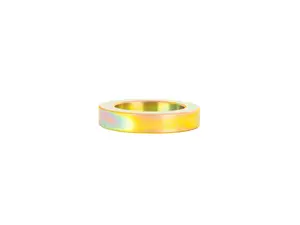
To solve this issue, many enthusiasts choose to run a clutched alternator pulley (also called an overrunning alternator pulley). A clutched pulley allows the alternator to "freewheel" or coast when the engine slows down, completely isolating its rotational inertia from the belt drive to prevent component wear. While the N52's clutched pulley (12317560483) is a straight bolt-on, the offset is incorrect for the E70 35d's accessory drive. Thankfully, our engineers designed this zinc-coated spacer to provide the precise amount of spacing needed to perfectly align the new pulley with existing belt drive components.
If you own an M57-equipped BMW, you already know this twin-turbo diesel powerplant is an absolute torque monster. What you might also know is that all that low-end grunt and high-compression diesel vibration wreaks absolute havoc on your accessory drive system.
From the factory, both the E90 335d and E70 X5 35d utilize a rigid alternator pulley. With each cylinder's fire, the crankshaft experiences a violent micro-acceleration. Because the alternator has a heavy internal rotor spinning at high speeds, it wants to keep spinning at a constant rate. When the engine suddenly slows down (even minutely between firing cycles), the alternator fights the belt. This constant tug-of-war results in extreme stress on your engine's belt-driven components. At best, it’s an annoying, unrefined chirp at idle; at worst, it’s a ticking time bomb for your expensive harmonic balancer.
To solve this issue, many enthusiasts choose to run a clutched alternator pulley (also called an overrunning alternator pulley). A clutched pulley allows the alternator to "freewheel" or coast when the engine slows down, completely isolating its rotational inertia from the belt drive to prevent component wear. While the N52's clutched pulley (12317560483) is a straight bolt-on, the offset is incorrect for the E70 X5 35d's accessory drive. Thankfully, our engineers designed this zinc-coated spacer to provide the precise amount of spacing needed to perfectly align the new pulley with existing belt drive components.

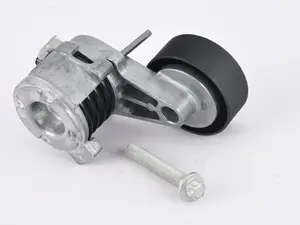
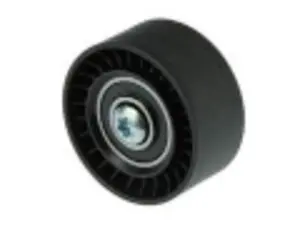
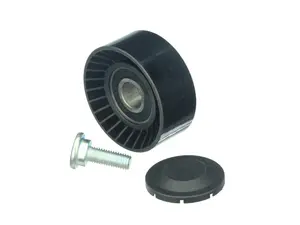
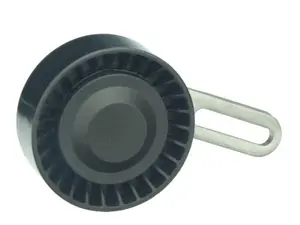
Ensure optimal cooling performance and extended belt life with the A/C Compressor Accessory Belt Tensioner. Engineered to deliver consistent tension, this tensioner is the key to maintaining efficient cabin cooling in your vehicle.
If you are experiencing a slipping compressor belt, you may notice a loss in cabin cooling performance or a high-pitched noise emitted from the vehicle's engine bay. If you are experiencing either of these issues, it's time to replace your tensioner.