Most Influential BMW Projects Ever
With a history spanning a century, BMW has been one of the foremost producers of vehicles. They have consistently demonstrated their motorsport prowess, and creativity through some of the most iconic vehicles ever designed, which is why we love them dearly. All those decades of invention, development, and testing have yielded some truly great cars, some we would consider being the best cars made for their time. Today, we’re taking a break from building exhaustive lists of what we would do to create the ‘ultimate’ versions of our favorite BMWs to step back and look at some of BMW’s contributions to automobiles. These are the top-5 most influential BMW projects that helped shape the world of automobiles as we know it.
|
|
Isetta
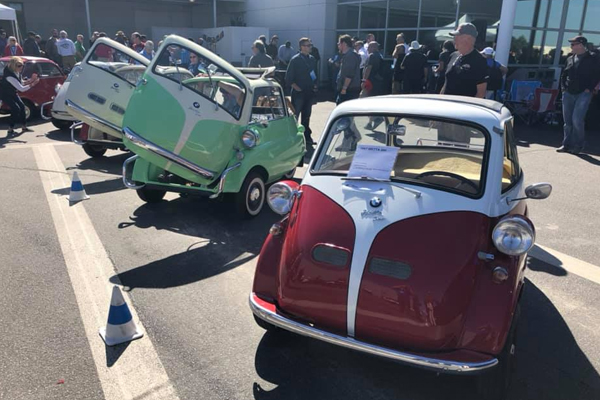
The BMW Isetta is the oldest and perhaps the strangest on this list, but that doesn’t make it insignificant. Despite its small stature, odd shape, and definitively not BMW-designed originally, the Isetta was widely influential in the European postwar era and still relevant today for its inspirations.
Originally, the Isetta was designed and produced by an Italian company, Iso, who manufactured scooters, motorcycles, and refrigerators. Clearly, they were the perfect company to introduce what has become known as the ‘first’ microcar with their long history of automotive success. Oddly enough, despite its identifiable Italian-ness, the Isetta never took off in popularity with its home country. Its history didn’t end there, however.
The Isetta licensing rights were purchased by BMW, who fitted it with their 250cc motorcycle engine producing 12hp, changed one or two design elements like the headlights and bumpers, added a heater, and sold over 160,000 of them to Germans. Somehow, the single-door refrigerator on wheels became one of BMW's most successful cars at the time. Likely due to its affordability and ease of operation on the tight streets of Europe as they rebuilt after WWII.
After the Isetta came a wave of microcars who took advantage of Germany’s license laws, requiring only a motorcycle license to drive them, and the people rejoiced. Microcars exploded in popularity thanks to their low cost, convenience, and fun attitudes. As cars became more affordable and available, the movement lost steam, much like the little 250cc Isetta does when climbing a hill, but it was not gone forever. Still today, compact and fuel-efficient designs can trace their roots to BMW’s Isetta. The Smart ForTwo, MINI, and the Kei-cars of Japan are all descendants, more or less, of the Isetta. Thanks to BMW’s ability to market, manufacture, and distribute the Isetta, we have a category of vehicles that provide spunky joy to many drivers, even if the original ancestor was perhaps the slowest and most awkward thing to ever be called a ‘car.’
| |
|
2002
In the late 50’s and early 60’s, BMW began introducing compact sedans known as the Neue-Klasse (new class) 1600. Lightweight, M10-powered, economical sedans which had some spunk and were known for their nimble agility as well as spacious (relatively speaking) interiors. However, despite a number of improvements to the carburetors, they were still underpowered. The introduction of the 1602, a two-door variant, helped to improve performance due to the lower weight, but compared to the new competition in the Datsun 510, it was not as successful due to the higher price point.
That’s when two BMW employees, independently of each other, took the 2-liter engine variant of the M10 and stuffed them into their 1602s. With a noticeable increase in performance and little change to the impeccable balance of the 1602, they had made a real discovery.
Together, Alex von Falkenhausen and Helmut Werner Bönsch helped BMW introduce the 2002. A 2-liter, M10-powered, dual-carb, coupe that offered a performance advantage over the Datsun 510 and convenience over the Austin-Healey 3000. This helped cement BMW as the sports coupe of choice for hundreds of thousands of drivers and influenced BMW’s vehicle development through contemporary models produced even today.
The 2002, 2002Ti, 2002Tii, and 2002 Turbo are effectively the ancestors of BMW’s modern lineup. They gave way to the first 3-series, the E21, and were the formula BMW would use to dominate motorsports in the 80’s and 90’s. High strung, lightweight, nimble, compact sedans that favored handling and agility over outright power have defined BMW’s lineup until recent years.
| | |
|
Mclaren F1
In 1992, McLaren (famous for not being BMW,) released the F1. The McLaren F1 was the most expensive vehicle produced at that time, at a cool 1 million dollars, was the fastest road car at 230mph, and was the first all-carbon fiber monocoque vehicle ever. It was notorious for its unyielding performance, lack of driver-assist features like ABS, power brakes, or even a rear sway bar, and the screaming, gold foil surrounded, BMW V12 under the rear glass.
The F1 helped reinvigorate the supercar craze that was waning as the 90’s began. Until it ceased production in 1998, the F1 dominated everything any competing manufacturer could throw at it. With a no-limit approach to development and raw driving experience, the McLaren F1 was the best ‘drivers’ supercar ever produced, and the last to retain an analog approach to the market.
From the F1, the world saw Bugatti rise up to take the fastest road car title with their Veyron. Porsche introduced the Carrera GT. Ferrari gave us the Enzo and Koenigsegg the Agera R. However, none would ever match the pure, simple, direct driving experience of the F1. What the F1 did was show the world what the absolute best in driving could be in terms of total reliance on the driver. Bill Auberlen, our esteemed racing driver, had this to say:
“1998, I drove a Longtail at Le Mans. When you release that speed-limiter button on hot tires, I swear to God: I was better-looking, I was taller, I felt better about myself. It’s a car that has a spirit and a soul. You’re going down the Mulsanne at 200 mph. You could see the wheels light up from the carbon brakes, the flames coming out the back.” - Road and Track, August 2017
With such an esteemed history under its belt, and a BMW V12 under its rear clamshell, the F1 is perhaps the pinnacle of engineering that will never be surpassed in the automotive world. It existed in a time where driver assistance, convenience technology, and avant-garde styling was not needed to sell the car for its astonishing price. It was the last we will ever have as the height of pure performance.
|
|
E30 M3
Shortly before the McLaren was introduced, the spirit of the 2002 lived on with the BMW E30 M3. The first M-badged 3-series, the E30 M3 gave rise to a new line of performance road cars that were relatively attainable. While they didn’t sell well on their initial run in America, the rest of the world hungered for the lightweight, high-revving, peppy, rigid, predictable M3.
It was one of the winningest cars in motorsport history and has since become iconic for its boxy styling, spartan equipment, and driver-centric design. This car was simply put a driver’s car. It was BMW’s swan song and will never be matched in terms of spirit or personality as the BMW customer demands more convenience, more power, and more luxury each year. This was BMW’s first and last chance to create a racing car for the street, and they did just that.
Today, we have the E30 M3 to thank for the M3/M4 series of vehicles, the popularity of M- GmbH, and the super-sedans for which Europe has become known.
| |
|
Supra MK5
Once again, famous for not being BMW, Toyota is a motorsport legend those born after 1999 would likely find confusing. While recent decades have made Toyota synonymous with ‘practical reliability’ and ‘economic affordability,’ they were not always such a reserved company.
The 2000gt, the predecessor to the Supra, was one of Japan’s answers to European sports coupes. Not only did it compete, but it excelled at inspiring a generation of enthusiasts in Japan who would grow up to develop some of the most iconic and well-performing platforms the world has ever seen. From that lineage, the Supra was introduced.
Originally, the Supra was a trim level attached to the Celica. The Celica-Supra, which endured for the first two generations, was much like the 2002. It was a big engine in an otherwise reserved commuter car. After departing from the Celica name, though, the Supra found its own footing.
With the MK3, the Supra grew larger, longer, sleeker, and more powerful. It was aimed to compete with the Datsun Z-cars and eventually the GTR. The Supra made its mark with the introduction of a twin-turbo straight-six version for the MK3 generation and cemented itself as a worthy adversary to Godzilla. However, with the new MK4 Supra in the ’90s, it became known as the Godzilla killer. The 2JZGTE engine, sleek, sloping design, and unmistakable rear wing did the same as its great grandfather, the 2000gt, and inspired yet another generation of motorsport enthusiasts.
However, after the MK4 Supra ceased production, enthusiasts around the world were left itching for a revival that never came. For 19 years, the Supra name was absent from Toyota’s lineup, while Nissan persisted with the GTR. Meanwhile, BMW became one of the only manufacturers with a straight-six engine in their coupes and sedans, even offering a twin-turbo with the N54.
It was thanks to that hiatus, however, that BMW was tapped when the development of the MK5 Supra finally happened. Thanks to BMW’s expertise in designing powerful, yet reliable, straight-six twin-turbo engines, Toyota decided to partner with them much like they had with Subaru for the FR-S/GT-86 to revive the Supra name.
Now, we have another legendary engine in the making, thanks to the B58. Found in BMW’s Z4 and soon to be others, the B58 is a compact, extremely powerful, and incredibly tunable model that will help keep the iconic straight-six engine layout alive for more enthusiasts to enjoy.
Without the Supra, we would likely see a decline in straight-six equipped BMWs as the turbocharged 4-cylinder engines have replaced naturally aspirated straight sixes. However, with the rise in popularity and affordability of the MK5 Supra, we will have, at least for the time being, a non-M, twin-turbo, straight-six that reminds us of the glory days of motorsports.
| | |
|
| | |