


The Anatomy of Modern Disc Brakes
Disc brakes receive their nomenclature since they are a physical disc, or rotor, that is stopped by a caliper and pads which squeeze together against the friction surface. Brakes stop your car based on their coefficient of friction over a temperature range. They consist of your caliper, which has pistons that clamp the pads to the rotor, and are operated hydraulically through brake lines that lead up to your brake master cylinder. While all disc brakes are essentially the same parts, when we start looking for performance options, things become more complicated.
Coefficient of Friction & Temperature Range
Let’s take a step back and look at exactly what is happening over the course of you pressing your brake pedal and coming to the site. The coefficient of friction is basically how much bite your brakes have at a certain temperature.
On a normal street car, you want brake pads with a high friction coefficient at a low temperature. Since your brakes will basically be cold all the time, you don’t want to wait for them to gain temperature to be grabby enough to stop. The trade-off is that the brakes lose grabbiness as the temperature climbs. So if you ride your brakes down a hill, you will notice what is called "brake fade" as the pads leave their operating temperature range. This is why you would want to gear down or drop into a lower drive gear rather than ride the brakes so you don’t boil your fluid in the calipers or lose your brakes entirely.
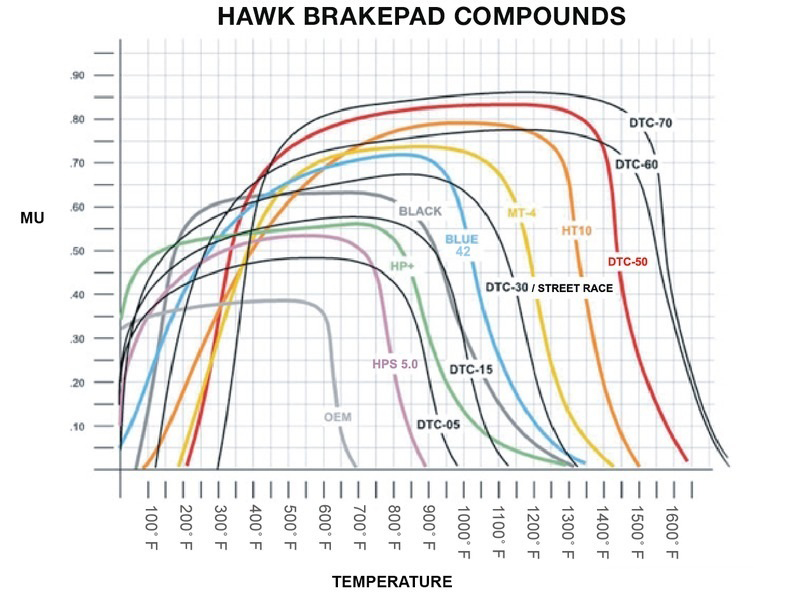
For a performance street car, you will want a pad compound that offers a high initial bite force and has a wide operating temperature so you can maintain brake force as the temperature climbs. The graph would be more like a flat line. While these pads may not have as high of an initial bite as basic passenger car economy brakes, they will significantly outperform those standard pads at high temperatures seen in hard driving and will resist fading. HAWK performance pads have a number of options for performance pad upgrade that are perfect for daily street driving and some moderate track use or aggressive driving, which we highly recommend for nearly all BMWs that see any road time.
Racing brakes have a graph that looks like the inverse of a standard economy car’s brakes. Racing brakes need their peak friction at much higher temperatures and require a good bit of heat to provide the stopping force necessary for competitive race cars. These brake pads are ill-advisable on the street, as you will not keep enough heat in the pads during standard driving to achieve adequate stopping force when you need it.
Types of Pads
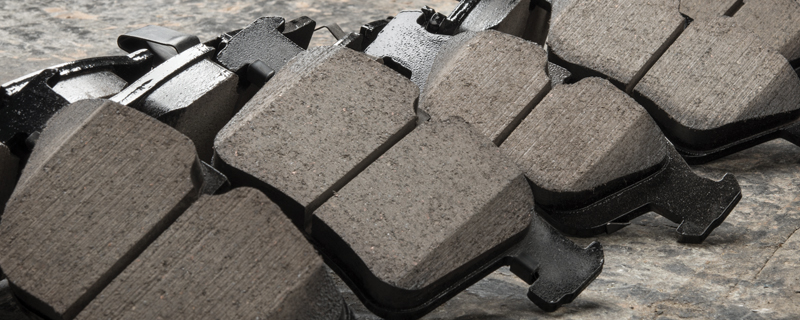
HAWK Performance is a go-to source for brake pads that are capable on the track and street without interchanging compounds. Your next brake service should include HAWK pads that will stop you on the street and perform under the hard driving that your BMW will coax out of you.
HAWK HPS pads are the original compound HAWK developed to provide added performance for your brakes on the street. These pads are a Ferro-Carbon compound and offer a wide temperature range that allows you to drive them with performance benefits on the street or some mild track use. They offer a smooth feel and bite with a remarkably controllable torque so you have the feedback you need without an overly aggressive bite force or ‘spongy’ lack of responsiveness.
The newly added HAWK HPS 5.0 pads are a step up from the HPS, but not a true replacement. These high performance pads offer an incredibly tight tolerance right at the line between the most torque you can have without kicking on the ABS and enough torque to provide a substantial increase in performance. They are also a Ferro-Carbon compound and will give your BMW better pedal feedback, low noise, low dust, and are also designed for street and track use. HPS 5.0 pads are the new go-to for a BMW driver who sees a wide range of driving conditions on the street and track. Everything from a simple trip to the store to a canyon-carving togue can be easily handled by these pads with greater performance and less fade than competitive street going pads.
Finally, the HAWK Street Race pads are the racing pads that allow you to drive your car on the track and back off with the ultimate in crossover braking performance. These pads use HAWK’s mechanical bond retention system, slotted friction, hot bod shim, and pad chamfer to improve your handling characteristics and braking characteristics on and off the track. These are the highest rated pads HAWK offers for both street and track use and are the best all-around pad for anyone driving in multiple scenarios that needs the absolute highest performance from their pads.
Which Pads Are Right For You
HAWK Performance is a go-to source for brake pads that are capable on the track and street without interchanging compounds. Your next brake service should include HAWK pads that will stop you on the street and perform under the hard driving that your BMW will coax out of you.
HAWK HPS pads are the original compound HAWK developed to provide added performance for your brakes on the street. These pads are a Ferro-Carbon compound and offer a wide temperature range that allows you to drive them with performance benefits on the street or some mild track use. They offer a smooth feel and bite with a remarkably controllable torque so you have the feedback you need without an overly aggressive bite force or ‘spongy’ lack of responsiveness.
The newly added HAWK HPS 5.0 pads are a step up from the HPS, but not a true replacement. These high performance pads offer an incredibly tight tolerance right at the line between the most torque you can have without kicking on the ABS and enough torque to provide a substantial increase in performance. They are also a Ferro-Carbon compound and will give your BMW better pedal feedback, low noise, low dust, and are also designed for street and track use. HPS 5.0 pads are the new go-to for a BMW driver who sees a wide range of driving conditions on the street and track. Everything from a simple trip to the store to a canyon-carving togue can be easily handled by these pads with greater performance and less fade than competitive street going pads.
Finally, the HAWK Street Race pads are the racing pads that allow you to drive your car on the track and back off with the ultimate in crossover braking performance. These pads use HAWK’s mechanical bond retention system, slotted friction, hot bod shim, and pad chamfer to improve your handling characteristics and braking characteristics on and off the track. These are the highest rated pads HAWK offers for both street and track use and are the best all-around pad for anyone driving in multiple scenarios that needs the absolute highest performance from their pads.
Calipers
Brake pads are clamped by calipers. The brake calipers, which are operated hydraulically, use an inner and outer pad to press against the rotor and provide friction that is turned into heat as the car stops. The performance of your calipers is dependent upon the size, force, and number of pistons pressing the pads together, the ability for the caliper to resist temperature increases, and to dispel heat quickly.
Standard disc brake calipers are generally a single or dual piston, cast iron, caliper. Improving your brakes generally can be left to better pads, like the HAWK pads outlined above, and with more capable rotors. In some cases, however, extreme brake performance is necessary and a greater friction surface with more bite force and better cooling properties is necessary. The theory behind big brakes is simple: adding surface area increases the amount of friction, adding pistons increases the bite force, and floating designs offer improved cooling to resist fade with the faster increase in temperatures from the larger brake components. Big brakes allow you to improve your stopping power well beyond the capabilities of your factory calipers and rotors for street use and racing use, but are generally not considered necessary for anyone beginning their build. Advanced drivers and drivers of high-horsepower cars are the ones who will receive the biggest benefits from these ultra-high performance brake systems.
Brake pads are clamped by calipers. The brake calipers, which are operated hydraulically, use an inner and outer pad to press against the rotor and provide friction that is turned into heat as the car stops. The performance of your calipers is dependent upon the size, force, and number of pistons pressing the pads together, the ability for the caliper to resist temperature increases, and to dispel heat quickly.
Standard disc brake calipers are generally a single or dual piston, cast iron, caliper. Improving your brakes generally can be left to better pads, like the HAWK pads outlined above, and with more capable rotors. In some cases, however, extreme brake performance is necessary and a greater friction surface with more bite force and better cooling properties is necessary. The theory behind big brakes is simple: adding surface area increases the amount of friction, adding pistons increases the bite force, and floating designs offer improved cooling to resist fade with the faster increase in temperatures from the larger brake components. Big brakes allow you to improve your stopping power well beyond the capabilities of your factory calipers and rotors for street use and racing use, but are generally not considered necessary for anyone beginning their build. Advanced drivers and drivers of high-horsepower cars are the ones who will receive the biggest benefits from these ultra-high performance brake systems.
Drilled & Slotted vs. Slotted vs. Full Face
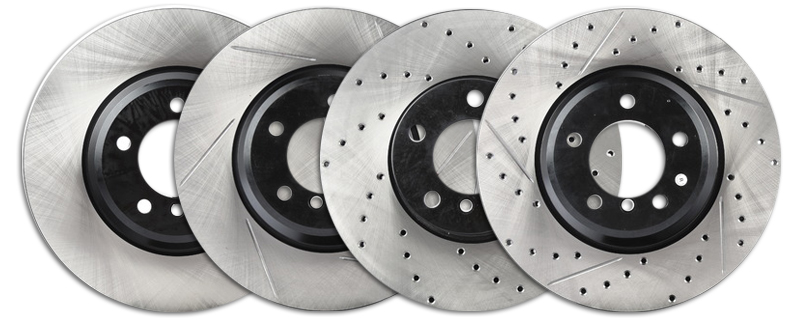
Rotors are traditionally full faces that are just a spinning friction disc for your pads to clamp against and stop the car. The flat face offers the largest surface area, so full face rotors are actually the highest initial bite force rotors and would be recommended for the best performance on a street car.
Slotted rotors have channels that allow heat gas and brake dust to escape, which will reduce temperatures quickly and resists brake fade. As we mentioned earlier, though, only during competition do these benefit you the most since they actually have less surface area than full face rotors. They do, however, hold up over a wider range than full face rotors by resisting that fade and maintaining a consistent pedal feel for a variety of driving conditions. The slotted design is excellent for anyone looking for a performance upgrade that will allow them to take full advantage of their BMW during aggressive driving by further resisting fade and allowing for a wide temperature range for optimal operation.
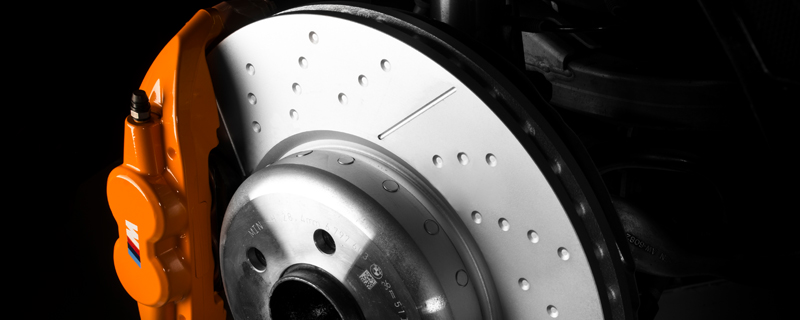
Cross Drilled rotors have holes drilled into them that allow heat gas and brake dust to escape, which will reduce temperatures quickly and resists brake fade. As we mentioned earlier, though, only during competition do these benefit you the most since they actually have less surface area than full face rotors. They do, however, hold up over a wider range than full face rotors by resisting that fade and maintaining a consistent pedal feel for a variety of driving conditions. The drilled design is excellent for anyone looking for a performance upgrade that will allow them to take full advantage of their BMW during aggressive driving by further resisting fade and allowing for a wide temperature range for optimal operation.
Drilled and Slotted rotors are just for show. That’s it! The holes and slots further reduce the surface area of the rotors and dramatically decrease the temperatures of the rotors. While they are perfectly capable on the street, and do resist temperature increase more than any other style of rotors, we do not recommend drilled and slotted rotors for anything besides street and show use.
Which Rotors Are Right For You
Rotors are traditionally full faces that are just a spinning friction disc for your pads to clamp against and stop the car. The flat face offers the largest surface area, so full face rotors are actually the highest initial bite force rotors and would be recommended for the best performance on a street car.
Slotted rotors have channels that allow heat gas and brake dust to escape, which will reduce temperatures quickly and resists brake fade. As we mentioned earlier, though, only during competition do these benefit you the most since they actually have less surface area than full face rotors. They do, however, hold up over a wider range than full face rotors by resisting that fade and maintaining a consistent pedal feel for a variety of driving conditions. The slotted design is excellent for anyone looking for a performance upgrade that will allow them to take full advantage of their BMW during aggressive driving by further resisting fade and allowing for a wide temperature range for optimal operation.
Cross Drilled rotors have holes drilled into them that allow heat gas and brake dust to escape, which will reduce temperatures quickly and resists brake fade. As we mentioned earlier, though, only during competition do these benefit you the most since they actually have less surface area than full face rotors. They do, however, hold up over a wider range than full face rotors by resisting that fade and maintaining a consistent pedal feel for a variety of driving conditions. The drilled design is excellent for anyone looking for a performance upgrade that will allow them to take full advantage of their BMW during aggressive driving by further resisting fade and allowing for a wide temperature range for optimal operation.
Drilled and Slotted rotors are just for show. That’s it! The holes and slots further reduce the surface area of the rotors and dramatically decrease the temperatures of the rotors. While they are perfectly capable on the street, and do resist temperature increase more than any other style of rotors, we do not recommend drilled and slotted rotors for anything besides street and show use.
Brake Lines
Your brake lines deliver fluid to the brake calipers which hydraulically clamp against the rotors and stop your BMW. Brake lines are traditionally rubber lines with metal fittings, which are perfectly fine for daily driving and even some hard driving. However, as your demands for performance increase, it is important to receive as much feedback from your pedal inputs as possible and for your fluid lines to have as much insulation as they can to resist temperature increases. Braided steel brake lines offer firmer pedal feel by resisting ‘stretching’ under fluid pressure and are better insulated than their rubber cousins which means your brake fluid stays cooler longer for higher performance driving.
Your brake lines deliver fluid to the brake calipers which hydraulically clamp against the rotors and stop your BMW. Brake lines are traditionally rubber lines with metal fittings, which are perfectly fine for daily driving and even some hard driving. However, as your demands for performance increase, it is important to receive as much feedback from your pedal inputs as possible and for your fluid lines to have as much insulation as they can to resist temperature increases. Braided steel brake lines offer firmer pedal feel by resisting ‘stretching’ under fluid pressure and are better insulated than their rubber cousins which means your brake fluid stays cooler longer for higher performance driving.